


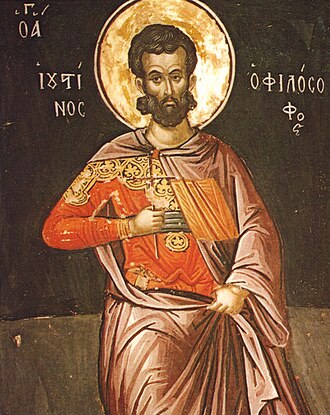
Justin Martyr · c. 100 – c. 165
First Apology; Dialogue with Trypho
c. 155–160 · Ante-Nicene Fathers vol. 1 (1885) · translated from the Greek
19pages
6 h 27 minreading time
182passages linked to Scripture
1,147links to verses
Contents
- The First Apology of Justin1
- Chapter I.—Address.1
- Chapter II.—Justice demanded.1
- Chapter III.—Claim of judicial investigation.1
- Chapter IV.—Christians unjustly condemned for their mere name.1
- Chapter V.—Christians charged with atheism.1
- Chapter VI.—Charge of atheism refuted.1
- Chapter VII.—Each Christian must be tried by his own life.1
- Chapter VIII.—Christians confess their faith in God.1
- Chapter IX.—Folly of idol worship.1
- Chapter X.—How God is to be served.1
- Chapter XI.—What kingdom Christians look for.1
- Chapter XII.—Christians live as under God's eye.1
- Chapter XIII.—Christians serve God rationally.1
- Chapter XIV.—The demons misrepresent Christian doctrine.1
- Chapter XV.—What Christ himself taught.1
- Chapter XVI.—Concerning patience and swearing.1
- Chapter XVII.—Christ taught civil obedience.1
- Chapter XVIII.—Proof of immortality and the resurrection.1
- Chapter XIX.—The resurrection possible.1
- Chapter XX.—Heathen analogies to Christian doctrine.2
- Chapter XXI.—Analogies to the history of Christ.2
- Chapter XXII.—Analogies to the sonship of Christ.2
- Chapter XXIII.—The argument.2
- Chapter XXIV.—Varieties of heathen worship.2
- Chapter XXV.—False Gods abandoned by Christians.2
- Chapter XXVI.—Magicians not trusted by Christians.2
- Chapter XXVII.—Guilt of exposing children.2
- Chapter XXVIII.—God's care for men.2
- Chapter XXIX.—Continence of Christians.2
- Chapter XXX.—Was Christ not a magician?2
- Chapter XXXI.—Of the Hebrew prophets.2
- Chapter XXXII.—Christ predicted by Moses.2
- Chapter XXXIII.—Manner of Christ's birth predicted.2
- Chapter XXXIV.—Place of Christ's birth foretold.2
- Chapter XXXV.—Other fulfilled prophecies.2
- Chapter XXXVI.—Different modes of prophecy.2
- Chapter XXXVII.—Utterances of the Father.2
- Chapter XXXVIII.—Utterances of the Son.2
- Chapter XXXIX.—Direct predictions by the Spirit.2
- Chapter XL.—Christ's advent foretold.2
- Chapter XLI.—The crucifixion predicted.3
- Chapter XLII.—Prophecy using the past tense.3
- Chapter XLIII.—Responsibility asserted.3
- Chapter XLIV.—Not nullified by prophecy.3
- Chapter XLV.—Christ's session in heaven foretold.3
- Chapter XLVI.—The Word in the world before Christ.3
- Chapter XLVII.—Desolation of Judæa foretold.3
- Chapter XLVIII.—Christ's work and death foretold.3
- Chapter XLIX.—His rejection by the Jews foretold.3
- Chapter L.—His humiliation predicted.3
- Chapter LI.—The majesty of Christ.3
- Chapter LII.—Certain fulfilment of prophecy.3
- Chapter LIII.—Summary of the prophecies.3
- Chapter LIV.—Origin of heathen mythology.3
- Chapter LV.—Symbols of the cross.3
- Chapter LVI.—The demons still mislead men.3
- Chapter LVII.—And cause persecution.3
- Chapter LVIII.—And raise up heretics.3
- Chapter LIX.—Plato's obligation to Moses.3
- Chapter LX.—Plato's doctrine of the cross.4
- Chapter LXI.—Christian baptism.4
- Chapter LXII.—Its imitation by demons.4
- Chapter LXIII.—How God appeared to Moses.4
- Chapter LXIV.—Further misrepresentations of the truth.4
- Chapter LXV.—Administration of the sacraments.4
- Chapter LXVI.—Of the Eucharist.4
- Chapter LXVII.—Weekly worship of the Christians.4
- Chapter LXVIII.—Conclusion.4
- Epistle of Adrian in behalf of the Christians.5
- The Second Apology of Justin for the Christians Addressed to the Roman Senate5
- Chapter I.—Introduction.5
- Chapter II.—Urbicus condemns the Christians to death.5
- Chapter III.—Justin accuses Crescens of ignorant prejudice against the Christians.5
- Chapter IV.—Why the Christians do not kill themselves.5
- Chapter V.—How the angels transgressed.5
- Chapter VI.—Names of God and of Christ, their meaning and power.5
- Chapter VII.—The world preserved for the sake of Christians. Man's responsibility.5
- Chapter VIII.—All have been hated in whom the Word has dwelt.5
- Chapter IX.—Eternal punishment not a mere threat.5
- Chapter X.—Christ compared with Socrates.5
- Chapter XI.—How Christians view death.5
- Chapter XII.—Christians proved innocent by their contempt of death.5
- Chapter XIII.—How the Word has been in all men.5
- Chapter XIV.—Justin prays that this appeal be published.5
- Chapter XV.—Conclusion.5
- Dialogue of Justin, Philosopher and Martyr, with Trypho, a Jew6
- Chapter I.—Introduction.6
- Chapter II.—Justin describes his studies in philosophy.6
- Chapter III.—Justin narrates the manner of his conversion.6
- Chapter IV.—The soul of itself cannot see God.6
- Chapter V.—The soul is not in its own nature immortal.6
- Chapter VI.—These things were unknown to Plato and other philosophers.6
- Chapter VII.—The knowledge of truth to be sought from the prophets alone.6
- Chapter VIII.—Justin by his colloquy is kindled with love to Christ.6
- Chapter IX.—The Christians have not believed groundless stories.6
- Chapter X.—Trypho blames the Christians for this alone—the non-observance of the law.6
- Chapter XI.—The law abrogated; the New Testament promised and given by God.6
- Chapter XII.—The Jews violate the eternal law, and interpret ill that of Moses.6
- Chapter XIII.—Isaiah teaches that sins are forgiven through Christ's blood.7
- Chapter XIV.—Righteousness is not placed in Jewish rites, but in the conversion of the heart given in baptism by Christ7
- Chapter XV.—In what the true fasting consists.7
- Chapter XVI.—Circumcision given as a sign, that the Jews might be driven away for their evil deeds done to Christ and t7
- Chapter XVII.—The Jews sent persons through the whole earth to spread calumnies on Christians.7
- Chapter XVIII.—Christians would observe the law, if they did not know why it was instituted.7
- Chapter XIX.—Circumcision unknown before Abraham. The law was given by Moses on account of the hardness of their hearts7
- Chapter XX.—Why choice of meats was prescribed.7
- Chapter XXI.—Sabbaths were instituted on account of the people's sins, and not for a work of righteousness.7
- Chapter XXII.—So also were sacrifices and oblations.7
- Chapter XXIII.—The opinion of the Jews regarding the law does an injury to God.7
- Chapter XXIV.—The Christians' circumcision far more excellent.7
- Chapter XXV.—The Jews boast in vain that they are sons of Abraham.8
- Chapter XXVI.—No salvation to the Jews except through Christ.8
- Chapter XXVII.—Why God taught the same things by the prophets as by Moses.8
- Chapter XXVIII.—True righteousness is obtained by Christ.8
- Chapter XXIX.—Christ is useless to those who observe the law.8
- Chapter XXX.—Christians possess the true righteousness.8
- Chapter XXXI.—If Christ's power be now so great, how much greater at the second advent!8
- Chapter XXXII.—Trypho objecting that Christ is described as glorious by Daniel, Justin distinguishes two advents.8
- Chapter XXXIII.—Ps. cx. is not spoken of Hezekiah. He proves that Christ was first humble, then shall be glorious.8
- Chapter XXXIV.—Nor does Ps. lxxii. apply to Solomon, whose faults Christians shudder at.8
- Chapter XXXV.—Heretics confirm the Catholics in the faith.8
- Chapter XXXVI.—He proves that Christ is called Lord of Hosts.8
- Chapter XXXVII.—The same is proved from other Psalms.9
- Chapter XXXVIII.—It is an annoyance to the Jew that Christ is said to be adored. Justin confirms it, however, from Ps.9
- Chapter XXXIX.—The Jews hate the Christians who believe this. How great the distinction is between both!9
- Chapter XL.—He returns to the Mosaic laws, and proves that they were figures of the things which pertain to Christ.9
- Chapter XLI.—The oblation of fine flour was a figure of the Eucharist.9
- Chapter XLII.—The bells on the priest's robe were a figure of the apostles.9
- Chapter XLIII.—He concludes that the law had an end in Christ, who was born of the Virgin.9
- Chapter XLIV.—The Jews in vain promise themselves salvation, which cannot be obtained except through Christ.9
- Chapter XLV.—Those who were righteous before and under the law shall be saved by Christ.9
- Chapter XLVI.—Trypho asks whether a man who keeps the law even now will be saved. Justin proves that it contributes not9
- Chapter XLVII.—Justin communicates with Christians who observe the law. Not a few Catholics do otherwise.9
- Chapter XLVIII.—Before the divinity of Christ is proved, he [Trypho] demands that it be settled that He is Christ.9
- Chapter XLIX.—To those who object that Elijah has not yet come, he replies that he is the precursor of the first advent9
- Chapter L.—It is proved from Isaiah that John is the precursor of Christ.10
- Chapter LI.—It is proved that this prophecy has been fulfilled.10
- Chapter LII.—Jacob predicted two advents of Christ.10
- Chapter LIII.—Jacob predicted that Christ would ride on an ass, and Zechariah confirms it.10
- Chapter LIV.—What the blood of the grape signifies.10
- Chapter LV.—Trypho asks that Christ be proved God, but without metaphor. Justin promises to do so.10
- Chapter LVI.—God who appeared to Moses is distinguished from God the Father.10
- Chapter LVII.—The Jew objects, why is He said to have eaten, if He be God? Answer of Justin.10
- Chapter LVIII.—The same is proved from the visions which appeared to Jacob.10
- Chapter LIX.—God distinct from the Father conversed with Moses.11
- Chapter LX.—Opinions of the Jews with regard to Him who appeared in the bush.11
- Chapter LXI—Wisdom is begotten of the Father, as fire from fire.11
- Chapter LXII.—The words "Let Us make man" agree with the testimony of Proverbs.11
- Chapter LXIII.—It is proved that this God was incarnate.11
- Chapter LXIV.—Justin adduces other proofs to the Jew, who denies that he needs this Christ.11
- Chapter LXV.—The Jew objects that God does not give His glory to another. Justin explains the passage.11
- Chapter LXVI.—He proves from Isaiah that God was born from a virgin.11
- Chapter LXVII.—Trypho compares Jesus with Perseus; and would prefer [to say] that He was elected [to be Christ] on acco11
- Chapter LXVIII.—He complains of the obstinacy of Trypho; he answers his objection; he convicts the Jews of bad faith.11
- Chapter LXIX.—The devil, since he emulates the truth, has invented fables about Bacchus, Hercules, and Æsculapius.12
- Chapter LXX.—So also the mysteries of Mithras are distorted from the prophecies of Daniel and Isaiah.12
- Chapter LXXI.—The Jews reject the interpretation of the LXX., from which, moreover, they have taken away some passages.12
- Chapter LXXII.—Passages have been removed by the Jews from Esdras and Jeremiah.12
- Chapter LXXIII.—[The words] "From the wood" have been cut out of Ps. xcvi.12
- Chapter LXXIV.—The beginning of Ps. xcvi. is attributed to the Father [by Trypho]. But [it refers] to Christ by these w12
- Chapter LXXV.—It is proved that Jesus was the name of God in the book of Exodus.12
- Chapter LXXVI.—From other passages the same majesty and government of Christ are proved.12
- Chapter LXXVII.—He returns to explain the prophecy of Isaiah.12
- Chapter LXXVIII.—He proves that this prophecy harmonizes with Christ alone, from what is afterwards written.12
- Chapter LXXIX.—He proves against Trypho that the wicked angels have revolted from God.12
- Chapter LXXX.—The opinion of Justin with regard to the reign of a thousand years. Several Catholics reject it.12
- Chapter LXXXI.—He endeavours to prove this opinion from Isaiah and the Apocalypse.12
- Chapter LXXXII.—The prophetical gifts of the Jews were transferred to the Christians.13
- Chapter LXXXIII.—It is proved that the Psalm, "The Lord said to My Lord," etc., does not suit Hezekiah.13
- Chapter LXXXIV.—That prophecy, "Behold, a virgin," etc., suits Christ alone.13
- Chapter LXXXV.—He proves that Christ is the Lord of Hosts from Ps. xxiv., and from his authority over demons.13
- Chapter LXXXVI.—There are various figures in the Old Testament of the wood of the cross by which Christ reigned.13
- Chapter LXXXVII.—Trypho maintains in objection these words: "And shall rest on Him," etc. They are explained by Justin.13
- Chapter LXXXVIII.—Christ has not received the Holy Spirit on account of poverty.13
- Chapter LXXXIX.—The cross alone is offensive to Trypho on account of the curse, yet it proves that Jesus is Christ.13
- Chapter XC.—The stretched-out hands of Moses signified beforehand the cross.13
- Chapter XCI.—The cross was foretold in the blessings of Joseph, and in the serpent that was lifted up.13
- Chapter XCII.—Unless the scriptures be understood through God's great grace, God will not appear to have taught always13
- Chapter XCIII.—The same kind of righteousness is bestowed on all. Christ comprehends it in two precepts.13
- Chapter XCIV.—In what sense he who hangs on a tree is cursed.14
- Chapter XCV.—Christ took upon Himself the curse due to us.14
- Chapter XCVI.—That curse was a prediction of the things which the Jews would do.14
- Chapter XCVII.—Other predictions of the cross of Christ.14
- Chapter XCVIII.—Predictions of Christ in Ps. xxii.14
- Chapter XCIX.—In the commencement of the Psalm are Christ's dying words.14
- Chapter C.—In what sense Christ is [called] Jacob, and Israel, and Son of Man.14
- Chapter CI.—Christ refers all things to the Father14
- Chapter CII.—The prediction of the events which happened to Christ when He was born. Why God permitted it.14
- Chapter CIII.—The Pharisees are the bulls: the roaring lion is Herod or the devil.14
- Chapter CIV.—Circumstances of Christ's death are predicted in this Psalm.14
- Chapter CV.—The Psalm also predicts the crucifixion and the subject of the last prayers of Christ on Earth.14
- Chapter CVI.—Christ's resurrection is foretold in the conclusion of the Psalm.14
- Chapter CVII.—The same is taught from the history of Jonah.14
- Chapter CVIII.—The resurrection of Christ did not convert the Jews. But through the whole world they have sent men to a15
- Chapter CIX.—The conversion of the Gentiles has been predicted by Micah.15
- Chapter CX.—A portion of the prophecy already fulfilled in the Christians: the rest shall be fulfilled at the second ad15
- Chapter CXI.—The two advents were signified by the two goats. Other figures of the first advent, in which the Gentiles15
- Chapter CXII.—The Jews expound these signs jejunely and feebly, and take up their attention only with insignificant mat15
- Chapter CXIII.—Joshua was a figure of Christ.15
- Chapter CXIV.—Some rules for discerning what is said about Christ. The circumcision of the Jews is very different from15
- Chapter CXV.—Prediction about the Christians in Zechariah. The malignant way which the Jews have in disputations.15
- Chapter CXVI.—It is shown how this prophecy suits the Christians.15
- Chapter CXVII.—Malachi's prophecy concerning the sacrifices of the Christians. It cannot be taken as referring to the p15
- Chapter CXVIII.—He exhorts to repentance before Christ comes; in whom Christians, since they believe, are far more reli15
- Chapter CXIX.—Christians are the holy people promised to Abraham. They have been called like Abraham.15
- Chapter CXX.—Christians were promised to Isaac, Jacob, and Judah.15
- Chapter CXXI.—From the fact that the Gentiles believe in Jesus, it is evident that He is Christ.16
- Chapter CXXII.—The Jews understand this of the proselytes without reason.16
- Chapter CXXIII.—Ridiculous interpretations of the Jews. Christians are the true Israel.16
- Chapter CXXIV.—Christians are the sons of God.16
- Chapter CXXV.—He explains what force the word Israel has, and how it suits Christ.16
- Chapter CXXVI.—The various names of Christ according to both natures. It is shown that He is God, and appeared to the p16
- Chapter CXXVII.—These passages of Scripture do not apply to the Father, but to the Word.16
- Chapter CXXVIII.—The Word is sent not as an inanimate power, but as a person begotten of the Father's substance.16
- Chapter CXXIX.—That is confirmed from other passages of Scripture.16
- Chapter CXXX.—He returns to the conversion of the Gentiles, and shows that it was foretold.16
- Chapter CXXXI.—How much more faithful to God the Gentiles are who are converted to Christ than the Jews.16
- Chapter CXXXII.—How great the power was of the name of Jesus in the Old Testament.16
- Chapter CXXXIII.—The hard-heartedness of the Jews, for whom the Christians pray.16
- Chapter CXXXIV.—The marriages of Jacob are a figure of the Church.17
- Chapter CXXXV.—Christ is king of Israel, and Christians are the Israelitic race.17
- Chapter CXXXVI.—The Jews, in rejecting Christ, rejected God who sent him.17
- Chapter CXXXVII.—He exhorts the Jews to be converted.17
- Chapter CXXXVIII.—Noah is a figure of Christ, who has regenerated us by water, and faith, and wood: [i.e., the cross.]17
- Chapter CXXXIX.—The blessings, and also the curse, pronounced by Noah were prophecies of the future.17
- Chapter CXL.—In Christ all are free. The Jews hope for salvation in vain because they are sons of Abraham.17
- Chapter CXLI.—Free-will in men and angels.17
- Chapter CXLII.—The Jews return thanks, and leave Justin.17
- Justin on the Sole Government of God18
- Chapter I.—Object of the author.18
- Chapter II.—Testimonies to the unity of God.18
- Chapter III.—Testimonies to a future judgment.18
- Chapter IV.—God desires not sacrifices, but righteousness.18
- Chapter V.—The vain pretensions of false gods.18
- Chapter VI.—We should acknowledge one only God.18
- Fragments of the Lost Work of Justin on the Resurrection19
- Chapter I.—The self-evidencing power of truth.19
- Chapter II.—Objections to the resurrection of the flesh.19
- Chapter III.—If the members rise, must they discharge the same functions as now?19
- Chapter IV.—Must the deformed rise deformed?19
- Chapter V.—The resurrection of the flesh is not impossible.19
- Chapter VI.—The resurrection consistent with the opinions of the philosophers.19
- Chapter VII.—The body valuable in God's sight.19
- Chapter VIII.—Does the body cause the soul to sin?19
- Chapter IX.—The resurrection of Christ proves that the body rises.19
- Chapter X.—The body saved, and will therefore rise.19