


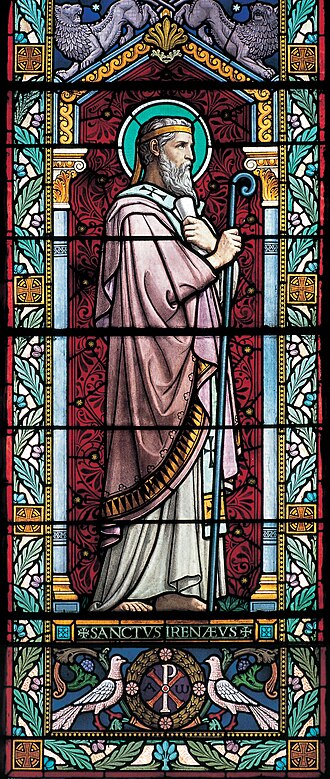
Irenaeus · c. 130 – c. 202
Against Heresies
c. 180 · Ante-Nicene Fathers vol. 1 (1885) · translated from the Greek (survives mostly in Latin)
37pages
14 h 47 minreading time
477passages linked to Scripture
2,799links to verses
Contents
- Against Heresies: Book I1
- Preface.1
- Chapter I.—Absurd ideas of the disciples of Valentinus as to the origin, name, order, and conjugal productions of their1
- Chapter II.—The Propator was known to Monogenes alone. Ambition, disturbance, and danger into which Sophia fell; her sh1
- Chapter III.—Texts of Holy Scripture used by these heretics to support their opinions.1
- Chapter IV.—Account given by the heretics of the formation of Achamoth; origin of the visible world from her disturbanc1
- Chapter V.—Formation of the Demiurge; description of him. He is the creator of everything outside of the Pleroma.2
- Chapter VI.—The threefold kind of man feigned by these heretics: good works needless for them, though necessary to othe2
- Chapter VII.—The mother Achamoth, when all her seed are perfected, shall pass into the Pleroma, accompanied by those me2
- Chapter VIII.—How the Valentinians pervert the Scriptures to support their own pious opinions.2
- Chapter IX.—Refutation of the impious interpretations of these heretics.3
- Chapter X.—Unity of the faith of the Church throughout the whole world.3
- Chapter XI.—The opinions of Valentinus, with those of his disciples and others.3
- Chapter XII.—The doctrines of the followers of Ptolemy and Colorbasus.3
- Chapter XIII.—The deceitful arts and nefarious practices of Marcus.3
- Chapter XIV.—The various hypotheses of Marcus and others. Theories respecting letters and syllables.4
- Chapter XV.—Sige relates to Marcus the generation of the twenty-four elements and of Jesus. Exposure of these absurditi4
- Chapter XVI.—Absurd interpretations of the Marcosians.4
- Chapter XVII.—The theory of the Marcosians, that created things were made after the image of things invisible.5
- Chapter XVIII.—Passages from Moses, which the heretics pervert to the support of their hypothesis.5
- Chapter XIX.—Passages of Scripture by which they attempt to prove that the Supreme Father was unknown before the coming5
- Chapter XX.—The apocryphal and spurious Scriptures of the Marcosians, with passages of the Gospels which they pervert.5
- Chapter XXI.—The views of redemption entertained by these heretics.5
- Chapter XXII.—Deviations of heretics from the truth.5
- Chapter XXIII.—Doctrines and practices of Simon Magus and Menander.5
- Chapter XXIV.—Doctrines of Saturninus and Basilides.6
- Chapter XXV.—Doctrines of Carpocrates.6
- Chapter XXVI.—Doctrines of Cerinthus, the Ebionites, and Nicolaitanes.6
- Chapter XXVII.—Doctrines of Cerdo and Marcion.6
- Chapter XXVIII.—Doctrines of Tatian, the Encratites, and others.6
- Chapter XXIX.—Doctrines of various other Gnostic sects, and especially of the Barbeliotes or Borborians.6
- Chapter XXX.—Doctrines of the Ophites and Sethians.6
- Chapter XXXI.—Doctrines of the Cainites.7
- Against Heresies: Book II7
- Preface.7
- Chapter I.—There is but one God: the impossibility of its being otherwise.7
- Chapter II.—The world was not formed by angels, or by any other being, contrary to the will of the most high God, but w7
- Chapter III.—The Bythus and Pleroma of the Valentinians, as well as the God of Marcion, shown to be absurd; the world w7
- Chapter IV.—The absurdity of the supposed vacuum and defect of the heretics is demonstrated.7
- Chapter V.—This world was not formed by any other beings within the territory which is contained by the Father.7
- Chapter VI.—The angels and the Creator of the world could not have been ignorant of the Supreme God.8
- Chapter VII.—Created things are not the images of those Æons who are within the Pleroma.8
- Chapter VIII.—Created things are not a shadow of the Pleroma.8
- Chapter IX.—There is but one Creator of the world, God the Father: this the constant belief of the Church.8
- Chapter X.—Perverse interpretations of Scripture by the heretics: God created all things out of nothing, and not from p8
- Chapter XI.—The heretics, from their disbelief of the truth, have fallen into an abyss of error: reasons for investigat8
- Chapter XII.—The Triacontad of the heretics errs both by defect and excess: Sophia could never have produced anything a8
- Chapter XIII.—The first order of production maintained by the heretics is altogether indefensible.9
- Chapter XIV.—Valentinus and his followers derived the principles of their system from the heathen; the names only are c9
- Chapter XV.—No account can be given of these productions.9
- Chapter XVI.—The Creator of the world either produced of Himself the images of things to be made, or the Pleroma was fo10
- Chapter XVII.—Inquiry into the production of the Æons: whatever its supposed nature, it is in every respect inconsisten10
- Chapter XVIII.—Sophia was never really in ignorance or passion; her Enthymesis could not have been separated from herse10
- Chapter XIX.—Absurdities of the heretics as to their own origin: their opinions respecting the Demiurge shown to be equ10
- Chapter XX.—Futility of the arguments adduced to demonstrate the sufferings of the twelfth Æon, from the parables, the11
- Chapter XXI.—The twelve apostles were not a type of the Æons.11
- Chapter XXII.—The thirty Æons are not typified by the fact that Christ was baptized in His thirtieth year: He did not s11
- Chapter XXIII.—The woman who suffered from an issue of blood was no type of the suffering Æon.11
- Chapter XXIV.—Folly of the arguments derived by the heretics from numbers, letters, and syllables.11
- Chapter XXV.—God is not to be sought after by means of letters, syllables, and numbers; necessity of humility in such i12
- Chapter XXVI.—"Knowledge puffeth up, but love edifieth."12
- Chapter XXVII.—Proper mode of interpreting parables and obscure passages of Scripture.12
- Chapter XXVIII.—Perfect knowledge cannot be attained in the present life: many questions must be submissively left in t12
- Chapter XXIX.—Refutation of the views of the heretics as to the future destiny of the soul and body.13
- Chapter XXX.—Absurdity of their styling themselves spiritual, while the Demiurge is declared to be animal.13
- Chapter XXXI.—Recapitulation and application of the foregoing arguments.13
- Chapter XXXII.—Further exposure of the wicked and blasphemous doctrines of the heretics.13
- Chapter XXXIII.—Absurdity of the doctrine of the transmigration of souls.14
- Chapter XXXIV.—Souls can be recognised in the separate state, and are immortal although they once had a beginning.14
- Chapter XXXV.—Refutation of Basilides, and of the opinion that the prophets uttered their predictions under the inspira14
- Against Heresies: Book III15
- Preface.15
- Chapter I.—The apostles did not commence to preach the Gospel, or to place anything on record until they were endowed w15
- Chapter II.—The heretics follow neither Scripture nor tradition.15
- Chapter III.—A refutation of the heretics, from the fact that, in the various Churches, a perpetual succession of bisho15
- Chapter IV.—The truth is to be found nowhere else but in the Catholic Church, the sole depository of apostolical doctri15
- Chapter V.—Christ and His apostles, without any fraud, deception, or hypocrisy, preached that one God, the Father, was15
- Chapter VI—The Holy Ghost, throughout the Old Testament Scriptures, made mention of no other God or Lord, save him who15
- Chapter VII.—Reply to an objection founded on the words of St. Paul (2 Cor. iv. 4). St. Paul occasionally uses words no15
- Chapter VIII.—Answer to an objection, arising from the words of Christ (Matt. vi. 24). God alone is to be really called16
- Chapter IX.—One and the same God, the Creator of heaven and earth, is He whom the prophets foretold, and who was declar16
- Chapter X.—Proofs of the foregoing, drawn from the Gospels of Mark and Luke.16
- Chapter XI—Proofs in continuation, extracted from St. John's Gospel. The Gospels are four in number, neither more nor l16
- Chapter XII.—Doctrine of the rest of the apostles.17
- Chapter XIII—Refutation of the opinion, that Paul was the only apostle who had knowledge of the truth.18
- Chapter XIV.—If Paul had known any mysteries unrevealed to the other apostles, Luke, his constant companion and fellow-18
- Chapter XV.—Refutation of the Ebionites, who disparaged the authority of St. Paul, from the writings of St. Luke, which18
- Chapter XVI.—Proofs from the apostolic writings, that Jesus Christ was one and the same, the only begotten Son of God,18
- Chapter XVII.—The apostles teach that it was neither Christ nor the Saviour, but the Holy Spirit, who did descend upon19
- Chapter XVIII.—Continuation of the foregoing argument. Proofs from the writings of St. Paul, and from the words of Our19
- Chapter XIX.—Jesus Christ was not a mere man, begotten from Joseph in the ordinary course of nature, but was very God,19
- Chapter XX.—God showed himself, by the fall of man, as patient, benign, merciful, mighty to save. Man is therefore most19
- Chapter XXI.—A vindication of the prophecy in Isa. vii. 14 against the misinterpretations of Theodotion, Aquila, the Eb20
- Chapter XXII.—Christ assumed actual flesh, conceived and born of the Virgin.20
- Chapter XXIII.—Arguments in opposition to Tatian, showing that it was consonant to divine justice and mercy that the fi20
- Chapter XXIV.—Recapitulation of the various arguments adduced against Gnostic impiety under all its aspects. The hereti21
- Chapter XXV.—This world is ruled by the providence of one God, who is both endowed with infinite justice to punish the21
- Against Heresies: Book IV21
- Preface.21
- Chapter I.—The Lord acknowledged but one God and Father.21
- Chapter II.—Proofs from the plain testimony of Moses, and of the other prophets, whose words are the words of Christ, t21
- Chapter III.—Answer to the cavils of the Gnostics. We are not to suppose that the true God can be changed, or come to a21
- Chapter IV.—Answer to another objection, showing that the destruction of Jerusalem, which was the city of the great Kin21
- Chapter V.—The author returns to his former argument, and shows that there was but one God announced by the law and pro22
- Chapter VI.—Explanation of the words of Christ, "No man knoweth the Father, but the Son," etc.; which words the heretic22
- Chapter VII.—Recapitulation of the foregoing argument, showing that Abraham, through the revelation of the Word, knew t22
- Chapter VIII.—Vain attempts of Marcion and his followers, who exclude Abraham from the salvation bestowed by Christ, wh22
- Chapter IX.—There is but one author, and one end to both covenants.22
- Chapter X.—The Old Testament Scriptures, and those written by Moses in particular, do everywhere make mention of the So23
- Chapter XI.—The old prophets and righteous men knew beforehand of the advent of Christ, and earnestly desired to see an23
- Chapter XII.—It clearly appears that there was but one author of both the old and the new law, from the fact that Chris23
- Chapter XIII.—Christ did not abrogate the natural precepts of the law, but rather fulfilled and extended them. He remov23
- Chapter XIV.—If God demands obedience from man, if He formed man, called him and placed him under laws, it was merely f23
- Chapter XV.—At first God deemed it sufficient to inscribe the natural law, or the Decalogue, upon the hearts of men; bu23
- Chapter XVI.—Perfect righteousness was conferred neither by circumcision nor by any other legal ceremonies. The Decalog24
- Chapter XVII.—Proof that God did not appoint the Levitical dispensation for His own sake, or as requiring such service;24
- Chapter XVIII.—Concerning sacrifices and oblations, and those who truly offer them.24
- Chapter XIX.—Earthly things may be the type of heavenly, but the latter cannot be the types of others still superior an24
- Chapter XX.—That one God formed all things in the world, by means of the Word and the Holy Spirit: and that although He25
- Chapter XXI.—Abraham's faith was identical with ours; this faith was prefigured by the words and actions of the old pat25
- Chapter XXII.—Christ did not come for the sake of the men of one age only, but for all who, living righteously and piou26
- Chapter XXIII.—The patriarchs and prophets by pointing out the advent of Christ, fortified thereby, as it were, the way26
- Chapter XXIV.—The conversion of the Gentiles was more difficult than that of the Jews; the labours of those apostles, t26
- Chapter XXV.—Both covenants were prefigured in Abraham, and in the labour of Tamar; there was, however, but one and the26
- Chapter XXVI.—The treasure hid in the Scriptures is Christ; the true exposition of the Scriptures is to be found in the26
- Chapter XXVII—The sins of the men of old time, which incurred the displeasure of God, were, by His providence, committe26
- Chapter XXVIII.—Those persons prove themselves senseless who exaggerate the mercy of Christ, but are silent as to the j27
- Chapter XXIX.—Refutation of the arguments of the Marcionites, who attempted to show that God was the author of sin, bec27
- Chapter XXX.—Refutation of another argument adduced by the Marcionites, that God directed the Hebrews to spoil the Egyp27
- Chapter XXXI.—We should not hastily impute as crimes to the men of old time those actions which the Scripture has not c27
- Chapter XXXII.—That one God was the author of both Testaments, is confirmed by the authority of a presbyter who had bee27
- Chapter XXXIII.—Whosoever confesses that one God is the author of both Testaments, and diligently reads the Scriptures27
- Chapter XXXIV.—Proof against the Marcionites, that the prophets referred in all their predictions to our Christ.28
- Chapter XXXV.—A refutation of those who allege that the prophets uttered some predictions under the inspiration of the28
- Chapter XXXVI.—The prophets were sent from one and the same Father from whom the Son was sent.28
- Chapter XXXVII.—Men are possessed of free will, and endowed with the faculty of making a choice. It is not true, theref29
- Chapter XXXVIII.—Why man was not made perfect from the beginning.29
- Chapter XXXIX.—Man is endowed with the faculty of distinguishing good and evil; so that, without compulsion, he has the29
- Chapter XL.—One and the same God the Father inflicts punishment on the reprobate, and bestows rewards on the elect.29
- Chapter XLI.—Those persons who do not believe in God, but who are disobedient, are angels and sons of the devil, not in29
- Against Heresies: Book V30
- Preface.30
- Chapter I.—Christ alone is able to teach divine things, and to redeem us: He, the same, took flesh of the Virgin Mary,30
- Chapter II.—When Christ visited us in His grace, He did not come to what did not belong to Him: also, by shedding His t30
- Chapter III.—The power and glory of God shine forth in the weakness of human flesh, as He will render our body a partic30
- Chapter IV.—Those persons are deceived who feign another God the Father besides the Creator of the world; for he must h30
- Chapter V.—The prolonged life of the ancients, the translation of Elijah and of Enoch in their own bodies, as well as t30
- Chapter VI.—God will bestow salvation upon the whole nature of man, consisting of body and soul in close union, since t30
- Chapter VII.—Inasmuch as Christ did rise in our flesh, it follows that we shall be also raised in the same; since the r31
- Chapter VIII.—The gifts of the Holy Spirit which we receive prepare us for incorruption, render us spiritual, and separ31
- Chapter IX.—Showing how that passage of the apostle which the heretics pervert, should be understood; viz., "Flesh and31
- Chapter X.—By a comparison drawn from the wild olive-tree, whose quality but not whose nature is changed by grafting, h31
- Chapter XI.—Treats upon the actions of carnal and of spiritual persons; also, that the spiritual cleansing is not to be31
- Chapter XII.—Of the difference between life and death; of the breath of life and the vivifying Spirit: also how it is t31
- Chapter XIII.—In the dead who were raised by Christ we possess the highest proof of the resurrection; and our hearts ar32
- Chapter XIV.—Unless the flesh were to be saved, the Word would not have taken upon Him flesh of the same substance as o32
- Chapter XV.—Proofs of the resurrection from Isaiah and Ezekiel; the same God who created us will also raise us up.32
- Chapter XVI.—Since our bodies return to the earth, it follows that they have their substance from it; also, by the adve32
- Chapter XVII.—There is but one Lord and one God, the Father and Creator of all things, who has loved us in Christ, give32
- Chapter XVIII.—God the Father and His Word have formed all created things (which They use) by Their own power and wisdo33
- Chapter XIX.—A comparison is instituted between the disobedient and sinning Eve and the Virgin Mary, her patroness. Var33
- Chapter XX.—Those pastors are to be heard to whom the apostles committed the Churches, possessing one and the same doct33
- Chapter XXI.—Christ is the head of all things already mentioned. It was fitting that He should be sent by the Father, t33
- Chapter XXII.—The true Lord and the one God is declared by the law, and manifested by Christ His Son in the Gospel; who33
- Chapter XXIII.—The devil is well practised in falsehood, by which Adam having been led astray, sinned on the sixth day33
- Chapter XXIV.—Of the constant falsehood of the devil, and of the powers and governments of the world, which we ought to33
- Chapter XXV.—The fraud, pride, and tyrannical kingdom of Antichrist, as described by Daniel and Paul.34
- Chapter XXVI.—John and Daniel have predicted the dissolution and desolation of the Roman Empire, which shall precede th34
- Chapter XXVII.—The future judgment by Christ. Communion with and separation from the divine being. The eternal punishme34
- Chapter XXVIII.—The distinction to be made between the righteous and the wicked. The future apostasy in the time of Ant34
- Chapter XXIX.—All things have been created for the service of man. The deceits, wickedness, and apostate power of Antic34
- Chapter XXX.—Although certain as to the number of the name of Antichrist, yet we should come to no rash conclusions as34
- Chapter XXXI.—The preservation of our bodies is confirmed by the resurrection and ascension of Christ: the souls of the35
- Chapter XXXII.—In that flesh in which the saints have suffered so many afflictions, they shall receive the fruits of th35
- Chapter XXXIII.—Further proofs of the same proposition, drawn from the promises made by Christ, when He declared that H35
- Chapter XXXIV.—He fortifies his opinions with regard to the temporal and earthly kingdom of the saints after their resu35
- Chapter XXXV.—He contends that these testimonies already alleged cannot be understood allegorically of celestial blessi35
- Chapter XXXVI.—Men shall be actually raised: the world shall not be annihilated; but there shall be various mansions fo36
- Fragments from the Lost Writings of Irenæus36
- I.36
- II.36
- III.36
- IV.36
- V.36
- VI.36
- VIII.36
- IX.36
- X.36
- XI.36
- XII.36
- XV.36
- XVI.36
- XVII.36
- XVIII.36
- XIX.36
- XXII.36
- XXIII.36
- XXIV.36
- XXV.36
- XXVI.36
- XXVII.36
- XXVIII.36
- XXIX.36
- XXXI.36
- XXXIII.36
- XXXIV.36
- XXXV.36
- XL.36
- XLI.36
- XLII.36
- XLIII.36
- XLIV.36
- XLV.36
- XLVI.36
- XLVII.36
- XLVIII.36
- XLIX.36
- L.36
- LI.36
- LII.36
- LIII.37
- LIV.37