


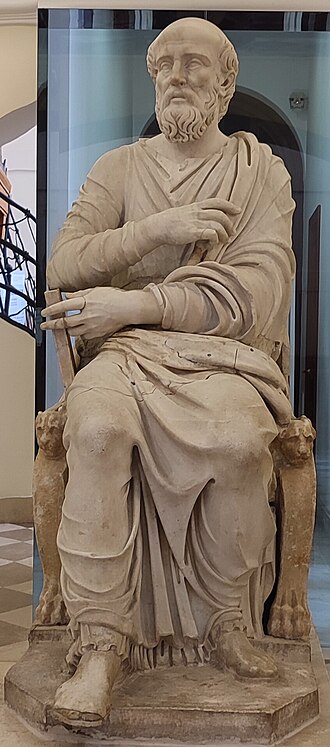
Hippolytus · c. 170 – c. 235
Refutation of All Heresies; On Christ and Antichrist; fragments on Daniel
c. 200–230 · Ante-Nicene Fathers vol. 5 (1886) · translated from the Greek · scanned edition
29pages in 2 volumes
11 h 25 minreading time
325passages linked to Scripture
1,131links to verses
Contents
Volume 1BY PONSONBY AND WELDRICK.pages 1–1
Volume 2Book I. – The Discourse on the Holy Theophany.pages 2–29
- Book I.2
- Chapter I.—Thales; His Physics and Theology; Founder of Greek Astronomy.2
- Chapter II.—Pythagoras; His Cosmogony; Rules of His Sect; Discoverer of Physiognomy; His Philosophy of Numbers; His Sys2
- Chapter III.—Empedocles; His Twofold Cause; Tenet of Transmigration.2
- Chapter IV.—Heraclitus; His Universal Dogmatism; His Theory of Flux; Other Systems.2
- Chapter V.—Anaximander; His Theory of the Infinite; His Astronomic Opinions; His Physics.2
- Chapter VI.—Anaximenes; His System of "An Infinite Air;" His Views of Astronomy and Natural Phenomena.2
- Chapter VII.—Anaxagoras; His Theory of Mind; Recognises an Efficient Cause; His Cosmogony and Astronomy.2
- Chapter VIII.—Archelaus; System Akin to that of Anaxagoras; His Origin of the Earth and of Animals; Other Systems.2
- Chapter IX.—Parmenides; His Theory of "Unity;" His Eschatology.2
- Chapter X.—Leucippus; His Atomic Theory.2
- Chapter XI.—Democritus; His Duality of Principles; His Cosmogony.2
- Chapter XII.—Xenophanes; His Scepticism; His Notions of God and Nature; Believes in a Flood.2
- Chapter XIII.—Ecphantus; His Scepticism; Tenet of Infinity.2
- Chapter XIV.—Hippo; His Duality of Principles; His Psychology.2
- Chapter XV.—Socrates; His Philosophy Reproduced by Plato.2
- Chapter XVI.—Plato; Threefold Classification of Principles; His Idea of God; Different Opinions Regarding His Theology2
- Chapter XVII.—Aristotle; Duality of Principles; His Categories; His Psychology; His Ethical Doctrines; Origin of the Ep3
- Chapter XVIII.—The Stoics; Their Superiority in Logic; Fatalists; Their Doctrine of Conflagrations.3
- Chapter XIX.—Epicurus; Adopts the Democritic Atomism; Denial of Divine Providence; The Principle of His Ethical System.3
- Chapter XX.—The Academics; Difference of Opinion Among Them.3
- Chapter XXI.—The Brachmans; Their Mode of Life; Ideas of Deity; Different Sorts Of; Their Ethical Notions.3
- Chapter XXII.—The Druids; Progenitors of Their System.3
- Chapter XXIII.—Hesiod; The Nine Muses; The Hesiodic Cosmogony; The Ancient Speculators, Materialists; Derivative Charac3
- Book IV.4
- Chapter I.—System of the Astrologers; Sidereal Influence; Configuration of the Stars.4
- Chapter II.—Doctrines Concerning Æons; The Chaldean Astrology; Heresy Derivable from It.4
- Chapter III.—The Horoscope the Foundation of Astrology; Indiscoverability of the Horoscope; Therefore the Futility of t4
- Chapter IV.—Impossibility of Fixing the Horoscope; Failure of an Attempt to Do This at the Period of Birth.4
- Chapter V.—Another Method of Fixing the Horoscope at Birth; Equally Futile; Use of the Clepsydra in Astrology; The Pred4
- Chapter VI.—Zodiacal Influence; Origin of Sidereal Names.4
- Chapter VII.—Practical Absurdity of the Chaldaic Art; Development of the Art.4
- Chapter VIII.—Prodigies of the Astrologers; System of the Astronomers; Chaldean Doctrine of Circles; Distances of the H4
- Chapter IX.—Further Astronomic Calculations.4
- Chapter X.—Theory of Stellar Motion and Distance in Accordance with Harmony.4
- Chapter XI.—Theory of the Size of the Heavenly Bodies in Accordance with Numerical Harmonies.4
- Chapter XII.—Waste of Mental Energy in the Systems of the Astrologers.4
- Chapter XIII.—Mention of the Heretic Colarbasus; Alliance Between Heresy and the Pythagorean Philosophy.4
- Chapter XIV.—System of the Arithmeticians; Predictions Through Calculations; Numerical Roots; Transference of These Doc4
- Chapter XV.—Quibbles of the Numerical Theorists; The Art of the Frontispicists (Physiognomy); Connection of This Art wi5
- Chapter XVI.—Type of Those Born Under Taurus.5
- Chapter XVII.—Type of Those Born Under Gemini.5
- Chapter XVIII.—Type of Those Born Under Cancer.5
- Chapter XIX.—Type of Those Born Under Leo.5
- Chapter XX.—Type of Those Born Under Virgo.5
- Chapter XXI.—Type of Those Born Under Libra.5
- Chapter XXII.—Type of Those Born Under Scorpio.5
- Chapter XXIII.—Type of Those Born Under Sagittarius.5
- Chapter XXIV.—Type of Those Born Under Capricorn.5
- Chapter XXV.—Type of Those Born Under Aquarius.5
- Chapter XXVI.—Type of Those Born Under Pisces.5
- Chapter XXVII.—Futility of This Theory of Stellar Influence.5
- Chapter XXVIII. —System of the Magicians; Incantations of Demons; Secret Magical Rites.5
- Chapter XXIX.—Display of Different Eggs.5
- Chapter XXX.—Self-Slaughter of Sheep.5
- Chapter XXXI.—Method of Poisoning Goats.5
- Chapter XXXII.—Imitations of Thunder, and Other Illusions.5
- Chapter XXXIII.—The Burning Æsculapius; Tricks with Fire.5
- Chapter XXXIV.—The Illusion of the Sealed Letters; Object in Detailing These Juggleries.5
- Chapter XXXV.—The Divination by a Cauldron; Illusion of Fiery Demons; Specimen of a Magical Invocation.5
- Chapter XXXVI.—Mode of Managing an Apparition.5
- Chapter XXXVII.—Illusive Appearance of the Moon.5
- Chapter XXXVIII.—Illusive Appearance of the Stars.6
- Chapter XXXIX.—Imitation of an Earthquake.6
- Chapter XL.—Trick with the Liver.6
- Chapter XLI.—Making a Skull Speak.6
- Chapter XLII.—The Fraud of the Foregoing Practices; Their Connection with Heresy.6
- Chapter XLIII.—Recapitulation of Theologies and Cosmogonies; System of the Persians; Of the Babylonians; The Egyptian N6
- Chapter XLIV.—Egyptian Theory of Nature; Their Amulets.6
- Chapter XLV.—Use of the Foregoing Discussions.6
- Chapter XLVI.—The Astrotheosophists; Aratus Imitated by the Heresiarchs; His System of the Disposition of the Stars.6
- Chapter XLVII.—Opinions of the Heretics Borrowed from Aratus.6
- Chapter XLVIII.—Invention of the Lyre; Allegorizing the Appearance and Position of the Stars; Origin of the Phoenicians6
- Chapter XLIX.—Symbol of the Creature; And of Spirit; And of the Different Orders of Animals.6
- Chapter L.—Folly of Astrology.6
- Chapter LI.—The Hebdomadarii; System of the Arithmeticians; Pressed into the Service of Heresy; Instances Of, in Simon6
- Book V.7
- Chapter I.—Recapitulation; Characteristics of Heresy; Origin of the Name Naasseni; The System of the Naasseni.7
- Chapter II.—Naasseni Ascribe Their System, Through Mariamne, to James the Lord's Brother; Really Traceable to the Ancie7
- Chapter III.—Further Exposition of the Heresy of the Naasseni; Profess to Follow Homer; Acknowledge a Triad of Principl7
- Chapter IV.—Further Use Made of the System of the Phrygians; Mode of Celebrating the Mysteries; The Mystery of the "Gre8
- Chapter V.—Explanation of the System of the Naasseni Taken from One of Their Hymns.8
- Chapter VI.—The Ophites the Grand Source of Heresy.8
- Chapter VII.—The System of the Peratæ; Their Tritheism; Explanation of the Incarnation.8
- Chapter VIII.—The Peratæ Derive Their System from the Astrologers; This Proved by a Statement of the Astrological Theor8
- Chapter IX.—System of the Peratæ Explained Out of One of Their Own Books.8
- Chapter X.—The Peratic Heresy Nominally Different from Astrology, But Really the Same System Allegorized.8
- Chapter XI.—Why They Call Themselves Peratæ; Their Theory of Generation Supported by an Appeal to Antiquity; Their Inte8
- Chapter XII.—Compendious Statement of the Doctrines of the Peratæ.9
- Chapter XIII.—The Peratic Heresy Not Generally Known.9
- Chapter XIV.—The System of the Sethians; Their Triad of Infinite Principles; Their Heresy Explained; Their Interpretati9
- Chapter XV.—The Sethians Support Their Doctrines by an Allegorical Interpretation of Scripture; Their System Really Der9
- Chapter XVI.—The Sethian Theory Concerning "Mixture" And "Composition;" Application of It to Christ; Illustration from9
- Chapter XVII.—The Sethian Doctrines to Be Learned from the "Paraphrase of Seth."9
- Chapter XVIII.—The System of Justinus Antiscriptural and Essentially Pagan.9
- Chapter XIX.—The Justinian Heresy Unfolded in the "Book of Baruch."9
- Chapter XX.—The Cosmogony of Justinus an Allegorical Explanation of Herodotus' Legend of Hercules.9
- Chapter XXI.—Justinus' Triad of Principles; His Angelography Founded on This Triad; His Explanation of the Birth, Life,9
- Chapter XXII.—Oath Used by the Justinian Heretics; The Book of Baruch; The Repertory of Their System.10
- Chapter XXIII.—Subsequent Heresies Deducible from the System of Justinus.10
- Book VI.10
- Chapter I. —The Ophites the Progenitors of Subsequent Heresies.10
- Chapter II.—Simon Magus.10
- Chapter III.—Story of Apsethus the Libyan.10
- Chapter IV.—Simon's Forced Interpretation of Scripture; Plagiarizes from Heraclitus and Aristotle; Simon's System of Se10
- Chapter V.—Simon Appeals to Scripture in Support of His System.10
- Chapter VI.—Simon's System Expounded in the Work, Great Announcement; Follows Empedocles.10
- Chapter VII.—Simon's System of a Threefold Emanation by Pairs.10
- Chapter VIII.—Further Progression of This Threefold Emanation; Co-Existence with the Double Triad of a Seventh Existenc10
- Chapter IX.—Simon's Interpretation of the Mosaic Hexaëmeron; His Allegorical Representation of Paradise.10
- Chapter X.—Simon's Explanation of the First Two Books of Moses.10
- Chapter XI.—Simon's Explanation of the Three Last Books of the Pentateuch.10
- Chapter XII.—Fire a Primal Principle, According to Simon.10
- Chapter XIII.—His Doctrine of Emanation Further Expanded.10
- Chapter XIV.—Simon Interprets His System by the Mythological Representation of Helen of Troy; Gives an Account of Himse10
- Chapter XV.—Simon's Disciples Adopt the Mysteries; Simon Meets St. Peter at Rome; Account of Simon's Closing Years.11
- Chapter XVI.—Heresy of Valentinus; Derived from Plato and Pythagoras.11
- Chapter XVII.—Origin of the Greek Philosophy.11
- Chapter XVIII.—Pythagoras' System of Numbers.11
- Chapter XIX.—Pythagoras' Duality of Substances; His "Categories."11
- Chapter XX.—Pythagoras' Cosmogony; Similar to that of Empedocles.11
- Chapter XXI.—Other Opinions of Pythagoras.11
- Chapter XXII.—The "Sayings" Of Pythagoras.11
- Chapter XXIII.—Pythagoras' Astronomic System.11
- Chapter XXIV.—Valentinus Convicted of Plagiarisms from the Platonic and Pythagoric Philosophy; The Valentinian Theory o11
- Chapter XXV.—The Tenet of the Duad Made the Foundation of Valentinus' System of the Emanation of Æons.11
- Chapter XXVI.—Valentinus' Explanation of the Existence of Christ and the Spirit.11
- Chapter XXVII.—Valentinus' Explanation of the Existence of Jesus; Power of Jesus Over Humanity.11
- Chapter XXVIII.—The Valentinian Origin of the Creation.12
- Chapter XXIX.—The Other Valentinian Emanations in Conformity with the Pythagorean System of Numbers.12
- Chapter XXX.—Valentinus' Explanation of the Birth of Jesus; Twofold Doctrine on the Nature of Jesus' Body; Opinion of t12
- Chapter XXXI.—Further Doctrines of Valentinus Respecting the Æons; Reasons for the Incarnation.12
- Chapter XXXII.—Valentinus Convicted of Plagiarisms from Plato.12
- Chapter XXXIII.—Secundus' System of Æons; Epiphanes; Ptolemæus.12
- Chapter XXXIV.—System of Marcus; A Mere Impostor; His Wicked Devices Upon the Eucharistic Cup.12
- Chapter XXXV.—Further Acts of Jugglery on the Part of Marcus.12
- Chapter XXXVI.—The Heretical Practices of the Marcites in Regard of Baptism.12
- Chapter XXXVII.—Marcus' System Explained by Irenæus; Marcus' Vision; The Vision of Valentinus Revealing to Him His Syst12
- Chapter XXXVIII.—Marcus' System of Letters.12
- Chapter XXXIX.—The Quaternion Exhibits "Truth."12
- Chapter XL.—The Name of Christ Jesus.13
- Chapter XLI.—Marcus' Mystic Interpretation of the Alphabet.13
- Chapter XLII.—His System Applied to Explain Our Lord's Life and Death.13
- Chapter XLIII—Letters, Symbols of the Heavens.13
- Chapter XLIV.—Respecting the Generation of the Twenty-Four Letters.13
- Chapter XLV.—Why Jesus is Called Alpha.13
- Chapter XLVI.—Marcus' Account of the Birth and Life of Our Lord.13
- Chapter XLVII.—The System of Marcus Shown to Be that of Pythagoras, by Quotations from the Writings of Marcus' Follower13
- Chapter XLVIII.—Their Cosmogony Framed According to These Mystic Doctrines of Letters.13
- Chapter XLIX.—The Work of the Demiurge Perishable.13
- Chapter L.—Marcus and Colarbasus Refuted by Irenæus.13
- Book VII.14
- Chapter I.—Heresy Compared to (1) the Stormy Ocean, (2) the Rocks of the Sirens; Moral from Ulysses and the Sirens.14
- Chapter II.—The System of Basilides Derived from Aristotle.14
- Chapter III.—Sketch of Aristotle's Philosophy.14
- Chapter IV.—Aristotle's General Idea.14
- Chapter V.—Nonentity as a Cause.14
- Chapter VI.—Substance, According to Aristotle; The Predicates.14
- Chapter VII.—Aristotle's Cosmogony; His "Psychology;" His "Entelecheia;" His Theology; His Ethics; Basilides Follows Ar14
- Chapter VIII.—Basilides and Isidorus Allege Apostolic Sanction for Their Systems; They Really Follow Aristotle.14
- Chapter IX.—Basilides Adopts the Aristotelian Doctrine of "Nonentity."14
- Chapter X.—Origin of the World; Basilides' Account of the "Sonship."14
- Chapter XI.—The "Great Archon" Of Basilides.14
- Chapter XII.—Basilides Adopts the "Entelecheia" Of Aristotle.14
- Chapter XIII.—Further Explanation of the "Sonship."14
- Chapter XIV.—Whence Came the Gospel; The Number of Heavens According to Basilides; Explanation of Christ's Miraculous C15
- Chapter XV.—God's Dealings with the Creature; Basilides' Notion of (1) the Inner Man, (2) the Gospel; His Interpretatio15
- Chapter XVI.—The System of Saturnilus.15
- Chapter XVII.—Marcion; His Dualism; Derives His System from Empedocles; Sketch of the Doctrine of Empedocles.15
- Chapter XVIII.—Source of Marcionism; Empedocles Reasserted as the Suggester of the Heresy.15
- Chapter XIX.—The Heresy of Prepon; Follows Empedocles; Marcion Rejects the Generation of the Saviour.15
- Chapter XX.—The Heresy of Carpocrates; Wicked Doctrines Concerning Jesus Christ; Practise Magical Arts; Adopt a Metemps16
- Chapter XXI.—The System of Cerinthus Concerning Christ.16
- Chapter XXII.—Doctrine of the Ebionæans.16
- Chapter XXIII.—The Heresy of Theodotus.16
- Chapter XXIV.—The Melchisedecians; The Nicolaitans.16
- Chapter XXV.—The Heresy of Cerdon.16
- Chapter XXVI.—The Doctrines of Apelles; Philumene, His Prophetess.16
- Book VIII.17
- Chapter I.—Heresies Hitherto Refuted; Opinions of the Docetæ.17
- Chapter II.—Docetic Notion of the Incarnation; Their Doctrines of Æons; Their Account of Creation; Their Notion of a Fi17
- Chapter III.—Christ Undoes the Work of the Demiurge; Docetic Account of the Baptism and Death of Jesus; Why He Lived fo17
- Chapter IV.—Docetic Doctrine Derived from the Greek Sophists.17
- Chapter V.—Monoïmus; Man the Universe, According to Monoïmus; His System of the Monad.17
- Chapter VI.—Monoïmus' "Iota;" His Notion of the "Son of Man."17
- Chapter VII.—Monoïmus on the Sabbath; Allegorizes the Rod of Moses; Notion Concerning the Decalogue.17
- Chapter VIII.—Monoïmus Explains His Opinions in a Letter to Theophrastus; Where to Find God; His System Derived from Py17
- Chapter IX.—Tatian.17
- Chapter X.—Hermogenes; Adopts the Socratic Philosophy; His Notion Concerning the Birth and Body of Our Lord.17
- Chapter XI.—The Quartodecimans.17
- Chapter XII.—The Montanists; Priscilla and Maximilla Their Prophetesses; Some of Them Noetians.17
- Chapter XIII.—The Doctrines of the Encratites.18
- Book IX.18
- Chapter I.—An Account of Contemporaneous Heresy.18
- Chapter II.—Source of the Heresy of Noetus; Cleomenes His Disciple; Its Appearance at Rome During the Episcopates of Ze18
- Chapter III.—Noetianism an Offshoot from the Heraclitic Philosophy.18
- Chapter IV.—An Account of the System of Heraclitus.18
- Chapter V.—Heraclitus' Estimate of Hesiod; Paradoxes of Heraclitus; His Eschatology; The Heresy of Noetus of Heraclitea18
- Chapter VI.—Conduct of Callistus and Zephyrinus in the Matter of Noetianism; Avowed Opinion of Zephyrinus Concerning Je18
- Chapter VII.—The Personal History of Callistus; His Occupation as a Banker; Fraud on Carpophorus; Callistus Absconds; A18
- Chapter VIII.—Sect of the Elchasaites; Hippolytus' Opposition to It.19
- Chapter IX.—Elchasai Derived His System from Pythagoras; Practised Incantations.19
- Chapter X.—Elchasai's Mode of Administering Baptism; Formularies.19
- Chapter XI.—Precepts of Elchasai.19
- Chapter XII.—The Heresy of the Elchasaites a Derivative One.19
- Chapter XIII.—The Jewish Sects.19
- Chapter XIV.—The Tenets of the Esseni.19
- Chapter XV.—The Tenets of the Esseni Continued.19
- Chapter XVI.—The Tenets of the Esseni Continued.19
- Chapter XVII.—The Tenets of the Esseni Continued.19
- Chapter XVIII.—The Tenets of the Esseni Continued.19
- Chapter XIX.—The Tenets of the Esseni Continued.19
- Chapter XX.—The Tenets of the Esseni Concluded.19
- Chapter XXI.—Different Sects of the Esseni.19
- Chapter XXII.—Belief of the Esseni in the Resurrection; Their System a Suggestive One.19
- Chapter XXIII.—Another Sect of the Esseni: the Pharisees.19
- Chapter XXIV.—The Sadducees.19
- Chapter XXV.—The Jewish Religion.19
- Chapter XXVI.—Conclusion to the Work Explained.20
- Book X.20
- Chapter I.—Recapitulation.20
- Chapter II.—Summary of the Opinions of Philosophers.20
- Chapter III.—Summary of the Opinions of Philosophers Continued.20
- Chapter IV.—Summary of the Opinions of Philosophers Continued.20
- Chapter V.—The Naasseni.20
- Chapter VI.—The Peratæ.20
- Chapter VII.—The Sethians.20
- Chapter VIII.—Simon Magus.20
- Chapter IX.—Valentinus.20
- Chapter X.—Basilides.20
- Chapter XI.—Justinus.20
- Chapter XII.—The Docetæ.20
- Chapter XIII.—Monoïmus.21
- Chapter XIV.—Tatian.21
- Chapter XV.—Marcion and Cerdo.21
- Chapter XVI.—Apelles.21
- Chapter XVII.—Cerinthus.21
- Chapter XVIII.—The Ebionæans.21
- Chapter XIX.—Theodotus.21
- Chapter XX.—Melchisedecians.21
- Chapter XXI.—The Phrygians or Montanists.21
- Chapter XXII.—The Phrygians or Montanists Continued.21
- Chapter XXIII.—Noetus and Callistus.21
- Chapter XXIV.—Hermogenes.21
- Chapter XXV.—The Elchasaites.21
- Chapter XXVI.—Jewish Chronology.21
- Chapter XXVII.—Jewish Chronology Continued.21
- Chapter XXVIII.—The Doctrine of the Truth.21
- Chapter XXIX.—The Doctrine of the Truth Continued.21
- Chapter XXX.—The Author's Concluding Address.21
- Part I.—Exegetical.22
- On the Hexaëmeron, Or Six Days' Work.22
- On Genesis.22
- II.22
- III.22
- I.23
- II.23
- III.23
- I.23
- II.23
- III.24
- IV.24
- V.24
- VI.24
- I.25
- II.25
- III.25
- IV.25
- V.25
- VI.25
- VII.25
- VIII.25
- IX.25
- X.25
- XI.25
- XII.25
- Treatise on Christ and Antichrist.26
- Expository Treatise Against the Jews.27
- The conclusion is wanting.27
- Against the Heresy of One Noetus.27
- Fragment I.28
- Fragment II.28
- Fragment III.28
- Fragment IV.28
- Fragment V.28
- Fragment VI.28
- Fragment VII.28
- Fragment VIII.28
- The Discourse on the Holy Theophany.29
- I.29
- II.29
- III.29
- IV.29
- V.29
- VI.29
- VII.29
- VIII.29
- IX.29
- X.29
- XI.29
- I.29
- II.29