


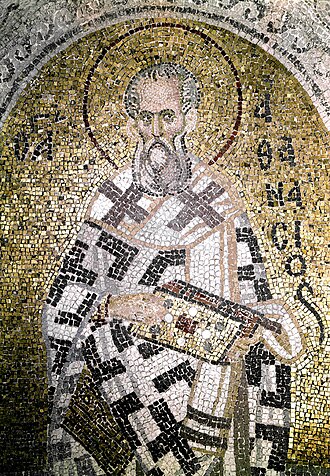
Athanasius · c. 296 – 373
Four Discourses Against the Arians; Festal Letters; Life of Antony
c. 339–367 · NPNF 2nd series vol. 4 (1892) · translated from the Greek
67pages
24 h 41 minreading time
682passages linked to Scripture
3,325links to verses
Contents
- Against the Heathen.1
- The deeds of heathen deities, and particularly of Zeus.1
- The folly of image worship and its dishonour to art.2
- Image worship condemned by Scripture.2
- The so-called gods of one place are used as victims in another.2
- Human sacrifice. Its absurdity. Its prevalence. Its calamitous results.2
- Part II.3
- Part III.4
- The same subject continued.4
- The Unity of God shewn by the Harmony of the order of Nature.4
- Impossibility of a plurality of Gods.4
- This function of the Word described at length.4
- Three similes to illustrate the Word's relation to the Universe.4
- The similes applied to the whole Universe, seen and unseen.4
- Conclusion. Doctrine of Scripture on the subject of Part I.4
- Doctrine of Scripture on the subject of Part 3.4
- Statement of Faith.5
- On Luke X. 22 (Matt. XI. 27).5
- This text refers not to the eternal Word but to the Incarnate.5
- By all things' is meant the redemptive attributes and power of Christ.5
- The same text further explained.5
- The Trisagion wrongly explained by Arians. Its true significance.5
- Circular Letter.6
- The whole Church affected by what has occurred.6
- Violent and Uncanonical Intrusion of Gregory.6
- Outrages which took place at the time of Gregory's arrival.6
- Outrages on Good Friday and Easter Day, 339.6
- Retirement of Athanasius, and tyranny of Gregory and Philagrius.6
- Appeal to the bishops of the whole Church to unite against Gregory.6
- Defence Against the Arians.7
- Introduction.7
- Chapter II.—Letter of Julius to the Eusebians at Antioch.8
- Chapter III.—Letters of the Council of Sardica to the Churches of Egypt and of Alexandria, and to all Churches.9
- Chapter IV.—Imperial and Ecclesiastical Acts in Consequence of the Decision of the Council of Sardica.10
- Part II.11
- Chapter V.—Documents connected with the charges of the Meletians against S. Athanasius.11
- Chapter VI.—Documents connected with the Council of Tyre.11
- De Decretis or Defence of the Nicene Definition12
- Chapter I.—Introduction. The complaint of the Arians against the Nicene Council; their fickleness; they are like Jews;12
- Chapter II.—Conduct of the Arians towards the Nicene Council. Ignorant as well as irreligious to attempt to reverse an12
- Chapter III.—Two senses of the word Son, 1. adoptive; 2. essential; attempts of Arians to find a third meaning between12
- Chapter IV.—Proof of the Catholic Sense of the Word Son. Power, Word or Reason, and Wisdom, the names of the Son, imply13
- Chapter V.—Defence of the Council's Phrases, "from the essence," And "one in essence." Objection that the phrases are n13
- Chapter VI.—Authorities in Support of the Council. Theognostus; Dionysius of Alexandria; Dionysius of Rome; Origen.13
- Chapter VII.—On the Arian Symbol "Unoriginate." This term afterwards adopted by them; and why; three senses of it. A fo14
- On the Opinion of Dionysius.15
- Life of Antony.16
- To the Bishops of Egypt.18
- Chapter I.18
- Chapter II.18
- Defence Before Constantius.19
- Defence of His Flight.20
- Part I.21
- Arian Persecution Under Constantine.21
- Part II.21
- First Arian Persecution under Constantius.21
- Part III.22
- Part IV.23
- Second Arian Persecution under Constantius23
- Part V.24
- Persecution and Lapse of Liberius24
- Part VI.25
- Persecution and Lapse of Hosius25
- Part VII.26
- Persecution at Alexandria26
- Part VIII.27
- Discourse I.28
- Chapter I.—Introduction. Reason for writing; certain persons indifferent about Arianism; Arians not Christians, because28
- Chapter II.—Extracts from the Thalia of Arius. Arius maintains that God became a Father, and the Son was not always; th28
- Chapter III.—The Importance of the Subject. The Arians affect Scripture language, but their doctrine new, as well as un28
- Chapter IV.—That the Son is Eternal and Increate. These attributes, being the points in dispute, are first proved by di28
- Chapter V.—Subject Continued. Objection, that the Son's eternity makes Him coordinate with the Father, introduces the s29
- Chapter VI.—Subject Continued. Third proof of the Son's eternity, viz. from other titles indicative of His coessentiali29
- Chapter VII.—Objections to the Foregoing Proof. Whether, in the generation of the Son, God made One that was already, o29
- Chapter VIII.—Objections Continued. Whether we may decide the question by the parallel of human sons, which are born la29
- Chapter IX.—Objections Continued. Whether is the Unoriginate one or two? Inconsistent in Arians to use an unscriptural30
- Chapter X.—Objections Continued. How the Word has free will, yet without being alterable. He is unalterable because the30
- Chapter XI.—Texts Explained; And First, Phil. II. 9, 10 Various texts which are alleged against the Catholic doctrine:30
- Chapter XII.—Texts Explained; Secondly, Psalm xlv. 7, 8. Whether the words therefore,' anointed,' &c., imply that the W31
- Chapter XIII.—Texts Explained; Thirdly, Hebrews i. 4. Additional texts brought as objections; e.g. Heb. i. 4; vii. 22.31
- Discourse II.32
- Chapter XIV.—Texts explained; Fourthly, Hebrews iii. 2 Introduction; the Regula Fidei counter to an Arian sense of the32
- Chapter XV.—Texts explained; Fifthly, Acts ii. 36. The Regula Fidei must be observed; madeapplies to our Lord's manhood32
- Chapter XVI.—Introductory to Proverbs viii. 22, that the Son is not a Creature. Arian formula, a creature but not as on33
- Chapter XVII.—Introduction to Proverbs viii. 22 continued. Absurdity of supposing a Son or Word created in order to the33
- Chapter XVIII.—Introduction to Proverbs viii. 22 continued. Contrast between the Father's operations immediately and na34
- Chapter XIX.—Texts explained; Sixthly, Proverbs viii. 22. Proverbs are of a figurative nature, and must be interpreted35
- Chapter XX.—Texts Explained; Sixthly, Proverbs viii. 22 Continued. Our Lord is said to be created for the works,' i.e.35
- Chapter XXI.—Texts Explained; Sixthly, Proverbs viii. 22, Continued. Our Lord not said in Scripture to be created,' or36
- Chapter XXII.—Texts Explained; Sixthly, the Context of Proverbs viii. 22 Vz. 22-30 It is right to interpret this passag37
- Discourse III.38
- Chapter XXIII.—Texts Explained; Seventhly, John xiv. 10 Introduction. The doctrine of the coinherence. The Father and t38
- Chapter XXIV.—Texts Explained; Eighthly, John xvii. 3. and the Like. Our Lord's divinity cannot interfere with His Fath38
- Chapter XXV.—Texts Explained; Ninthly, John x. 30; xvii. 11, &c. Arian explanation, that the Son is one with the Father38
- Chapter XXVI.—Introductory to Texts from the Gospels on the Incarnation. Enumeration of texts still to be explained. Ar39
- Chapter XXVII.—Texts Explained; Tenthly, Matthew xi. 27; John iii. 35, &c. These texts intended to preclude the Sabelli39
- Chapter XXVIII.—Texts Explained; Eleventhly, Mark xiii. 32 and Luke ii. 52 Arian explanation of the former text is agai40
- Chapter XXIX.—Texts Explained; Twelfthly, Matthew xxvi. 39; John xii. 27, &c. Arian inferences are against the Regula F40
- Chapter XXX.—Objections continued, as in Chapters vii.—x. Whether the Son is begotten of the Father's will? This virtu41
- Discourse IV.42
- Arians date the Son's beginning earlier than Marcellus, &c.42
- Marcellian illustration from 1 Cor. xii. 4, refuted.43
- Part I. History of the Councils.44
- Part II. History of Arian Opinions.45
- Part III. On the Symbols Of the Essence' And Coessential.'46
- Postscript.47
- Tome or Synodal Letter to the People of Antioch.47
- Letter of Ninety Bishops of Egypt and Libya, including Athanasius.48
- Letter I.—For 329. Easter-day xi Pharmuthi; viii Id. April; Ær. Dioclet. 45; Coss. Constantinus Aug. VIII. Constantinus49
- Letter II.—For 330. Easter-day xxiv Pharmuthi; xiii Kal. Mai; Æra Dioclet. 46; Coss. Gallicianus, Valerius Symmachus; P50
- Letter III.—For 331. Easter-day xvi Pharmuthi; iii Id. April; Æra Dioclet. 47; Coss. Annius Bassus, Ablabius; Præfect,51
- Letter IV.—For 332. Easter-day vii Pharmuthi, iv Non. Apr.; Æra Dioclet. 48; Coss. Fabius Pacatianus, Mæcilius H52
- Letter V.—For 333. Easter-day, Coss. Dalmatius and Zenophilus; Præfect, Paternus; vi Indict.; xvii Kal. M52
- Letter VI.—For 334. Easter-day, xii Pharmuthi, vii Id. April; xvii Moon; Æra Dioclet. 50; Coss. Optatus Patricius, Anic53
- Letter VII.—For 335. Easter-day iv Pharmuthi, iii Kal. April; xx Moon; Ær. Dioclet. 51; Coss. Julius Constantius, the b54
- Letter X.—For 338. Coss. Ursus and Polemius; Præf. the same Theodorus, of Heliopolis, and of the Catholics. Afte55
- Letter XI.—For 339. Coss. Constantius Augustus II, Constans I; Præfect, Philagrius the Cappadocian, for the second time56
- Letter XIII.—(For 341.) Coss. Marcellinus, Probinus; Præf. Longinus; Indict. xiv; Easter-day, xiii Kal. Maii, xxiv Phar57
- Letter XIV.—(For 342.) Coss. Augustus Constantius III, Constans II, Præf. the same Longinus; Indict. xv; Easter-day iii58
- Letter XVII.—(For 345.) Coss. Amantius, Albinus; Præf. Nestorius of Gaza; Indict. iii; Easter-day, vii Id. Apr., xii Ph58
- Letter XVIII.—(For 346.) Coss. Augustus Constantius IV, Constans III; Præf. the same Nestorius; Indict. iv; Easter-day58
- Letter XIX.—(For 347.) Coss. Rufinus, Eusebius; Præf. the same Nestorius; Indict. v; Easter-day, Prid. Id. Apr., Pharmu59
- Letter XX.—(For 348.) Coss. Philippus, Salia; Præfect the same Nestorius; Indict. vi; Easter-day iii Non. Apr., viii Ph60
- From Letter XXII.—(For 350.)60
- From Letter XXIV.—(For 352.)60
- From Letter XXVIII.—(For 356.)60
- Another Fragment.60
- From Letter XL.—(For 368.)60
- From Letter XLII.—(For 370.)60
- From Letter XLIII.—(For 371.)60
- From Letter XLV.—(For 373.)60
- Letter XLVI.—Letter to the Mareotis from Sardica, a.d. 343-4.61
- Letter XLVII.—To the Church of Alexandria on the same occasion.61
- Letter XLVIII.—Letter to Amun. Written before 354 a.d.61
- Letter XLIX.—Letter to Dracontius. Written a.d. 354 or 355.62
- Letter L.—First Letter to Lucifer.63
- Letter LI.—Second Letter to Lucifer.63
- Letter LII.—First Letter to Monks. (Written 358-360).63
- Letter LIII.—Second Letter to Monks.64
- Letter LIV.—To Serapion, concerning the death of Arius.64
- Letter LV.—Letter to Rufinianus.64
- Letter LVI.—To the Emperor Jovian.65
- Letter LVII.—First Letter to Orsisius.65
- Letter LVIII.—Second Letter to Orsisius.65
- Letter LIX.—To Epictetus.65
- Letter LX.—To Adelphius, Bishop and Confessor: against the Arians.66
- Letter LXI.—Letter to Maximus. (Written about 371 a.d.)67
- Letter LXII.—To John and Antiochus.67
- Letter LXIII.—Letter to the Presbyter Palladius.67
- Letter LXIV.—To Diodorus (fragment).67